unsmoke
smoking one cigarette
shouldn't reset you to zero
A streak has exactly one failure state. You smoke once, the counter goes to zero, and the app now says you have achieved nothing, which is precisely the moment people delete it. Unsmoke records that cigarette as a 2% change to something continuous instead. The slip still costs you, but it doesn't cost you the product.

- my role
- UX researchInteraction designUI & visual design
- users
- People smoking 5+ yearsRepeat quit attempters
- tools
- FigmaPhotoshop
- status
- Self-directed conceptMay 2024
READ THIS FIRST. Unsmoke is a self-directed concept. It was never engineered or released, so there is no analytics, no retention curve and no controlled comparison anywhere on this page. The one outcome I can point to, eight people who told me they cut down or stopped, is self-reported by a group I recruited myself. It is an anecdote, and I have labelled it as one. What follows is the design argument and the reasoning behind it.
the streak is the wrong
shape for this behaviour
Streaks are the default mechanic in habit apps, and for most habits they work. Meditation, running, language practice: you either did the thing or you didn't, and a run of consecutive days is a fair description of how you're doing.
Quitting is not shaped like that. Relapse isn't the exception, it's the documented path, and someone on their fifth attempt has usually made more progress than the counter can express. A streak turns the most fragile moment in the whole process into a total loss, and it does so with a number designed to feel like judgement. The person who most needs the app open tomorrow is the person the app just told they are back at day zero.
So the design question I set for myself was narrow: what does the app show you in the sixty seconds after you smoke? Everything else in Unsmoke follows from the answer.
The whole concept is this substitution: a discrete counter that can only be intact or destroyed, replaced with a continuous value that degrades and recovers.
the app asks before
the craving does
Most cravings are not random. They arrive with coffee, after lunch, on the drive home. During onboarding you set the times you already know are difficult, and the app meets you there instead of waiting to be opened.
At the appointed time Unsmoke asks one question: do you feel like smoking right now? Answer no and it logs a clean interval. Answer yes and you get the screen the rest of the product is built around, and the thing it does not do is argue with you.
The copy reads: it is okay if you wish to smoke right now. Then it asks for a moment, and offers a swipe in either direction. Left if you have changed your mind, right if you still want the cigarette. Both are legitimate. Both are one gesture.
Interception rather than prohibition. Note where the flow ends: whichever way you swipe, you finish inside the app, on a screen that still has something to show you. There is no exit that reads as failure.
“It is okay if you wish to smoke right now. Take a moment, if you change your mind and don't wish to smoke, swipe to the left.”
Interface copy · urge screen
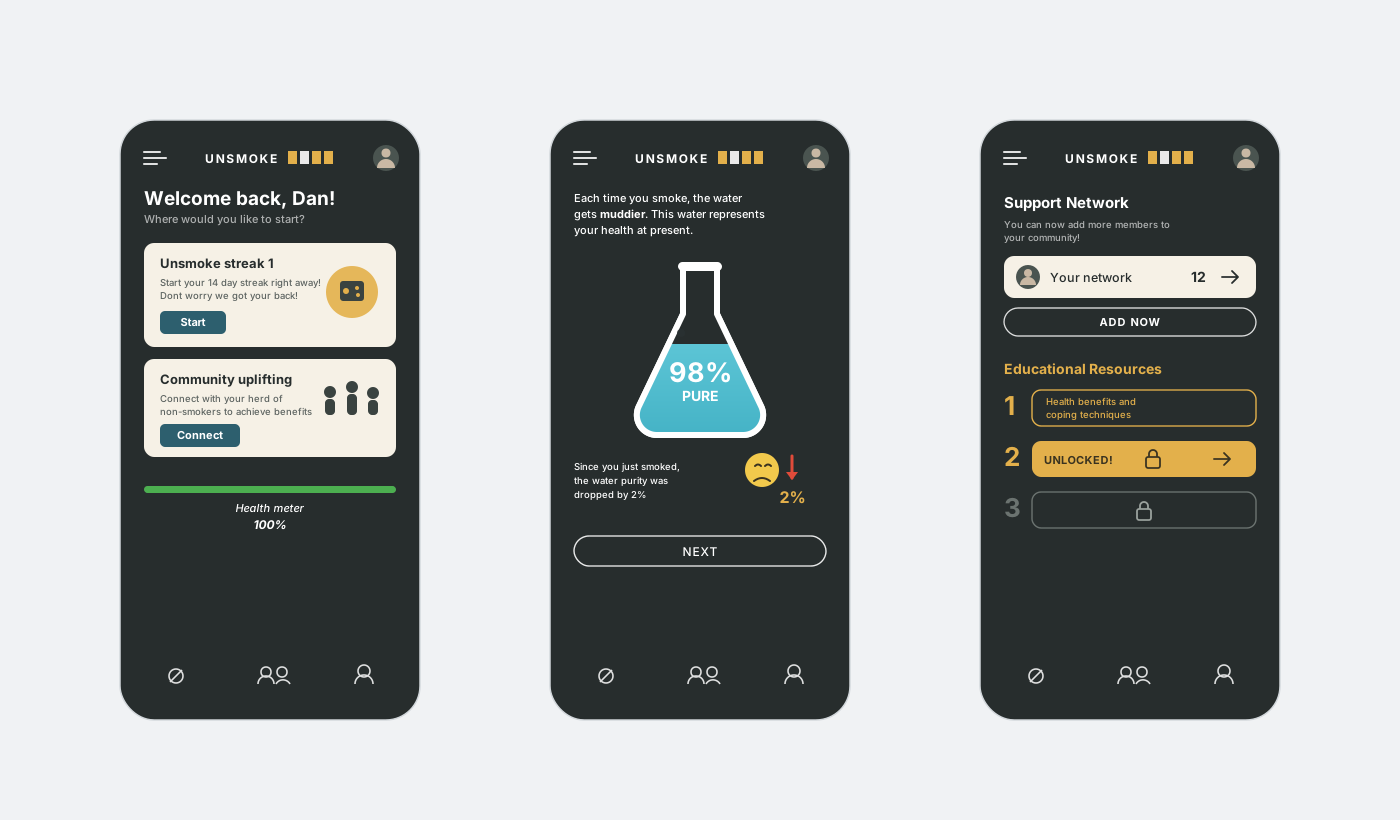
“Each time you smoke, the water gets muddier. This water represents your health at present.”
Interface copy · purity screen
a vessel of water,
standing in for lungs
The health variable needed a form. A percentage on its own is a number you learn to ignore, and a lung diagram is a medical image people flinch away from. I used a flask of clear water: it starts pure, it clouds when you smoke, and it clears as you go without.
It works as a mechanic rather than as decoration because water has the right physics built into the reader's head already. Nobody needs to be told that muddy water can be cleared, or that one drop of ink is not the same as a bottle. The metaphor carries the two properties the streak was missing, proportionality and reversibility, without a word of explanation.
proportional, so the cost is honest
One cigarette moves the value two points. It is a real loss and the interface does not soften it, but it is not framed as the destruction of everything you had built.
reversible, so there is a way back
Clean intervals restore purity. This is the property a streak counter structurally cannot have, and it is the entire reason for choosing a fluid.
continuous, so every day registers
Cutting from twenty a day to six is a large clinical improvement a streak scores as zero. The purity value moves, so the app can acknowledge reduction, not only abstinence.
Purity over a fortnight. Degradation is visible and so is recovery, which is what makes the variable worth looking at on a bad day rather than only on a good one.
three supports around
the central loop
The purity variable answers what happens when you slip. It doesn't, on its own, give anyone a reason to open the app on an ordinary Tuesday. Three further pieces carry that load, and each one is deliberately attached to the same underlying record.
streaks and challenges
A fourteen-day challenge with a progress ring, framed as a target you work toward rather than a possession you can lose. Weekly stats and history keep the trend visible even when a single day went badly, and a daily diary holds the context a number can't.
the support network
Other people going through the same attempt, with forums, chat and groups. Connecting to other challengers carries a benefit, so the social feature has a reason to exist beyond being present, quitting as a group rather than being watched by one.
resources you unlock
Health information and coping techniques, released by completing streaks rather than dumped in a library on day one. Gating means the material arrives when it's relevant, the one place I kept an unambiguous game mechanic, because the reward is genuinely useful.
Left to right: the daily home with the health meter reading at a glance, the purity screen immediately after a logged cigarette, and resources unlocking against completed streaks.
ON THE VISUALS. The screens above are redrawn from the original Figma file so they sit inside this site's grid and type. The source designs, including the onboarding and account flows, are on Behance.
One number, and it is a small one.
8+
people reported quitting or cutting down
5+
years smoking, the group this was designed for
0
users measured in a shipped product
ANECDOTE, NOT EVIDENCE. Eight people is a small group, I recruited them myself, they knew I had designed the thing, and I took their word for the outcome without verification. There was no control group and no follow-up past a few weeks. I include the number because it is the only outcome this project has, and I'd rather show it with the caveats attached than leave a gap where a result should be.
what I'd take apart
if I picked this up again
two per cent is a made-up number
It's the load-bearing constant in the entire system and I chose it because it felt proportionate. It should be derived from something: cigarettes per day, time since the last one, the shape of the person's own history. As it stands the twentieth cigarette of the day costs the same as the first, which is wrong in both directions.
the metaphor can turn on you
Muddy water representing your lungs is vivid, and vivid cuts both ways. For someone already ashamed of smoking, watching the flask darken could read as the app agreeing with the worst thing they think about themselves. I designed for the encouraging reading and never tested for the punitive one.
nobody used it mid-craving
Every design decision here is about what happens during a real urge, and I have no observation of a real urge. People walked through the flow calmly, which is the one state it was not built for.
gamifying a clinical problem needs more care than I gave it
Nicotine dependence has established treatment pathways. Unsmoke touches none of them, has no route to a cessation service or a clinician, and a serious version would need that referral built in rather than treated as out of scope.
recovery is asserted, not modelled
I show purity rising over clean days, but I never defined the rate or checked it against how lung function actually recovers. If the numbers are invented, a user who learns that stops trusting the display.
happy to be argued
with on the two per cent
This is the project where I am least sure I got the mechanic right, and the objections to gamifying addiction are good ones. The same question, what does a habit tool show you at the worst moment, carries into the next project, asked of a gentler behaviour.